The parts of a business letter, in order
Almost every professional letter uses the same sequence. Readers expect it, so following it makes your letter easier to scan.
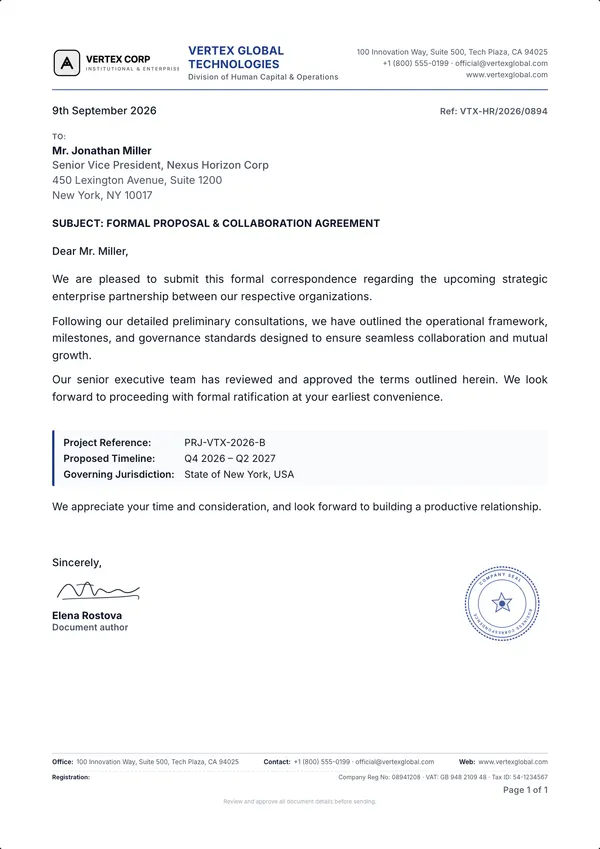
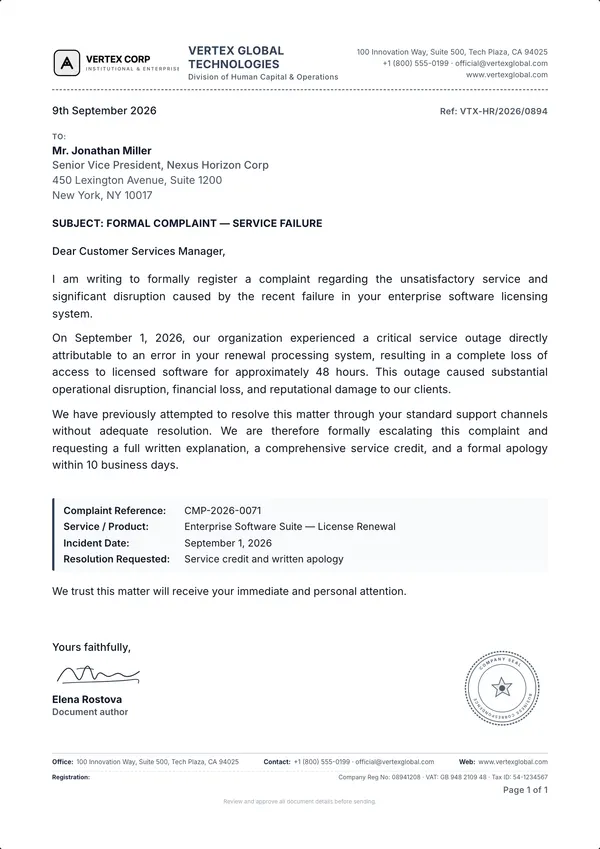
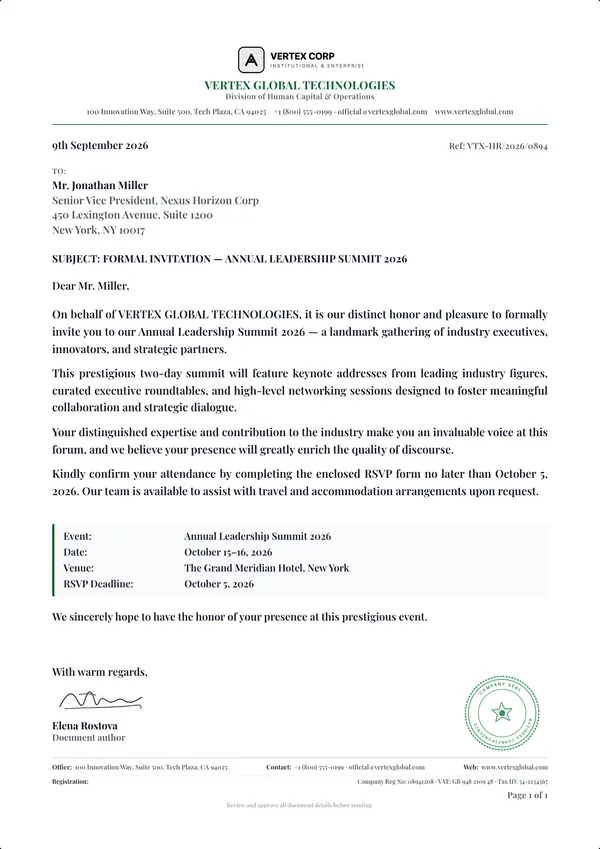
- Letterhead — your organisation's name, logo and contact details at the top. If you are writing as an individual, use your name and address instead.
- Date — written in full (for example 9 September 2026 or September 9, 2026) so there is no confusion between day and month.
- Reference (optional) — an invoice, case or file number so the recipient can match your letter to their records.
- Recipient's address — name, job title, organisation and postal address, exactly as you would write it on an envelope.
- Subject line — a short summary such as "Subject: Renewal of service agreement". It tells the reader what the letter is about before they start.
- Salutation — "Dear Ms Perera," or "Dear Hiring Manager," if you do not know the name.
- Body — usually three to five short paragraphs: why you are writing, the details, and what happens next.
- Closing sentence — a polite line that points to the next step, such as inviting questions.
- Complimentary close — "Sincerely," "Yours faithfully," or "Kind regards,".
- Signature block — your handwritten or digital signature, then your typed name, job title and department.
- Enclosures and copies (optional) — "Enclosure: Contract draft" or "cc: Finance Department".
Block format vs modified block format
Full block format is the most common style today. Every line starts at the left margin, paragraphs are separated by a blank line and are not indented. It looks modern and is the easiest to produce consistently.
Modified block format moves the date, complimentary close and signature block to start at the centre of the page, while the rest stays left-aligned. It feels more traditional and is still used in some legal and academic correspondence.
Tip: If you are unsure, use full block format. It is widely used and works best with letterheads and window envelopes.
Spacing, margins and fonts
- Margins: 20–25 mm (about 1 inch) on all sides. Narrow margins make a letter look cramped; very wide ones waste space on multi-page letters.
- Font: a clear, professional typeface such as Inter, Arial, Calibri, Georgia or Times New Roman at 10–12 pt.
- Line spacing: single spaced (1.0–1.15) within paragraphs, with one blank line between paragraphs.
- Length: one page wherever possible. If you need more, use continuation pages with a short header (your organisation and page number) rather than repeating the full letterhead.
- Alignment: left-aligned or justified body text. Justified text looks neat on letterhead but check that it does not create large gaps between words.
Making the address fit a window envelope (DIN 5008)
Window envelopes save time, but only if the recipient's address lands exactly in the window after folding. The German DIN 5008 standard fixes those positions, and it has become a reliable reference for A4 letters worldwide.
- The address field is 45 mm high and 85 mm wide, positioned about 45 mm from the top of the page and 20 mm from the left edge.
- Fold marks sit at 105 mm and 210 mm from the top, for the common Type B fold pattern; the panels are not equal thirds.
- A single-line return address above the recipient's address shows through the window too, in a smaller font.
Letter Studio provides an A4 layout based on these measurements. Print at actual size and test the fit against your envelope before sending.
A business letter example
VERTEX GLOBAL TECHNOLOGIES · 100 Innovation Way, Tech Plaza, CA 94025
9 September 2026
Ms Eleanor Vance
Head of Procurement, Nexus Horizon Corp
450 Lexington Avenue, New York, NY 10017
Subject: Proposal for managed cloud services
Dear Ms Vance,
Thank you for meeting our team last week. As discussed, I am pleased to enclose our proposal for managed cloud services covering migration, monitoring and 24/7 support.
The proposal sets out a phased migration over twelve weeks, a fixed monthly fee and service levels with guaranteed response times. It can start as early as 1 November.
I would welcome the chance to walk you through it. Please let me know a time that suits you next week.
Sincerely,
Elena Rostova
Chief Operating Officer
Enclosure: Service proposal
Common mistakes to avoid
- Leaving out the date or subject line, which makes the letter hard to file and reference later.
- Mixing styles — for example indented paragraphs in a full block letter.
- Using "Yours faithfully" with a named recipient; British usage pairs it with "Dear Sir or Madam" and "Yours sincerely" with a name.
- Long, dense paragraphs. Keep each paragraph to one idea.
- A letterhead that shifts position between letters. Lock it into a template so every letter looks the same.
Turn a vague request into a useful letter
Before formatting, write down the one action you need the reader to take. A polished page will not rescue a message that leaves the recipient guessing. Separate the request, the evidence supporting it and the response details.
Vague: Please look into the delivery problem as soon as possible.
Specific: Order LS-104 was due on 12 October 2026 and has not arrived. Please confirm a revised delivery date by 16 October, or tell me how to cancel the undelivered items.
The second version supplies the reference, the problem and a clear response request. The dates are fictional: replace them with facts from your own records. Keep attachments relevant and name them in the letter so the reader can find the evidence.
Check the finished document
- Read the subject and final paragraph together: they should ask for the same action.
- Check the recipient's name against the salutation, and the sender's name against the signature.
- Confirm every amount, date and reference against the original records.
- Inspect the exported PDF for clipped text and page breaks. If posting, print at actual size and test the address in the envelope you will use.
Sources and scope
These references support the topics described below. Our worked examples are fictional and are not official forms. Requirements can differ by recipient and jurisdiction.
- Purdue OWL — Writing the Basic Business Letter
US business-letter structure and formatting conventions; adapt to the recipient's requirements.
- DIN Media — DIN 5008:2020-03
Official standard listing and scope. The full standard is a paid publication; this guide is a practical introduction, not a certification of compliance.
For a correction or a template issue, contact the Letter Studio team. We do not claim legal review or certification of these guides.